Long Twilight or Low Winter Sun? Two Northern Light Effects
Compare long twilight and low winter sun to see when northern ridges, paths and ground textures are easiest to read, and avoid mistaking shadows for slopes.
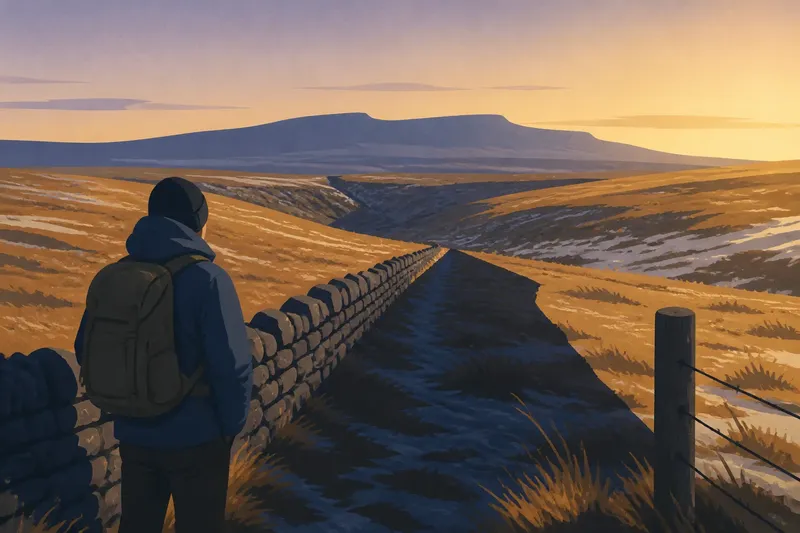
At the edge of a northern moor, a ridge can remain outlined after sunset while a fence post’s long shadow has already marked the ground. Long twilight and low winter sun show different details, so the useful question is what you need to see: distant outlines or nearby relief.
Twilight keeps the broad scene visible
Twilight is the period after the sun drops below the horizon, when sunlight still reaches the atmosphere. In northern regions, the sun’s shallow path can prolong the glow. The sky may remain softly lit even though direct sunlight no longer falls on the ground.
This diffuse light softens shadows. A track across open moorland, the edge of a pond or the general shape of a valley may remain visible, while small changes in slope become harder to distinguish. A low mound can blend into the land behind it.
Twilight is useful when you need to follow a skyline or read the broad layout of a landscape after sunset. It can also make the relationship between land and horizon easier to see, without one bright patch dominating the view.
Low winter sun reveals surface form
Sunlight arriving from near the horizon lays shadows across the ground. A rock, fence or snowbank can cast a long shadow, making small ridges and dips easier to pick out than they would be under higher, more direct light.
The effect depends on direction. A slope facing the sun may look bright while a neighbouring slope appears dark. The contrast can clarify a hillside’s shape, but it can also make the land seem more divided than it is. The shadows come from the light’s angle, not from a sudden change in the terrain.
Low sun can help reveal the folds of a hillside, the edge of a path or texture in rough grass and snow. It is less suitable for judging colour neutrally: warm illumination and deep shadows can alter how surfaces appear.
Choose the light for the detail you need
For route-finding across open ground, twilight may preserve a continuous view of the horizon; low sun may reveal nearby bumps and hollows. Neither replaces a map, compass or suitable light source when visibility is poor. Choose according to whether distant outlines or close relief matter more.
- To see a distant ridge after sunset: If the ridge contrasts with the twilight sky, use it as a visual landmark; if haze or cloud obscures the outline, check your position with a map and compass instead.
- To identify shallow ground features: If low sun casts clear side shadows, use those shadows to pick out rises and hollows; if they merge into dark patches, rely on a map or a closer view rather than guessing at the shape.
- To judge snow or rock colour: If the surface looks consistent under the available light, note its appearance cautiously; if twilight gives it a cool cast or low sun warms it, do not use colour alone to identify it.
- To photograph texture: If low sun gives the surface clear contrast, use it to show texture; if the shadows obscure detail, wait for softer light or change your viewpoint.
- To observe a broad landscape: If twilight leaves the horizon distinct, use it to follow the general scene; if moving shadows are the detail you need, observe them while low sun remains.
- To follow a path across a dip: If the path’s line is clear, keep to that visible route; if the dip or its edges are hard to read, pause and check your location rather than treating a shadow as the path.
Say you are beside a low stone wall and want to see whether a footpath continues across a shallow dip. In low winter sun, the wall’s shadow may make the dip easier to notice, but dark ground beyond it could look deeper than it is. After sunset, twilight may make the path’s general line easier to follow as the shadow fades, while the dip itself becomes less distinct; if you cannot tell where the route goes, stop and check your map rather than choosing by appearance.
Why do twilight and low sun change what you see?
Why does twilight flatten the ground?
After sunset, light comes from across much of the sky rather than as a direct beam from one low point. That fills in shadows and reduces the contrast that outlines bumps and hollows. The ground has not changed; its visible modelling has.
Why do winter shadows stretch so far?
When the sun is close to the horizon, its rays cross the ground at a shallow angle. Objects can therefore cast longer shadows than they do under a higher sun. The shadow’s direction indicates where the light comes from, not which way the land slopes.
Can twilight still show a ridge clearly?
Yes, if the sky remains bright enough and the ridge contrasts with its background. A ridge against a pale sky may stand out even when nearby details have softened. Cloud, haze and the ridge’s colour can all affect that contrast.
Which light is better for seeing a path?
Twilight may keep more of the open scene evenly visible, helping you follow a path’s general course. Low sun can reveal uneven ground near the path through side shadows. If either view is unclear, use a map and compass rather than treating the lighting effect as reliable route guidance.
Read shadows as clues, not measurements
A shadow can help reveal an object’s shape, but its length alone does not tell you the object’s size. The sun’s position and the ground beneath it both matter. Compare the shadow with nearby features rather than treating it as a ruler laid across the landscape.
Twilight can also make familiar features lose contrast before the sky looks dark. A pale track may blend into pale grass, while dark water can resemble a hollow. Check the boundary between land and sky, and use a map or known landmark to confirm what you are seeing.
Match the light to the question
Long twilight and low winter sun are not competing versions of good visibility. Twilight suits an even view beyond sunset; low sun suits close inspection of terrain where shadows reveal form. Each brings some details forward and lets others recede.
Before setting out, decide whether you need to recognise a skyline, a shallow dip, a route across open ground or the texture of a slope. Long twilight or low winter sun is easier to interpret once you know which detail matters, and a long shadow is less likely to be mistaken for a long hill.